
Back to blog
Aug 23, 2026
Reference Video AI: Seedance 2.5 Anime Workflow | MkAnime
Use first-frame, last-frame, motion, character, and storyboard references in Seedance 2.5 to preserve anime identity and scene continuity across shots.
Aug 23, 2026
Use first-frame, last-frame, motion, character, and storyboard references in Seedance 2.5 to preserve anime identity and scene continuity across shots.
Build the smallest reference set that locks your character's identity, then let Seedance 2.5 carry it across first frames, motion, and storyboard context.
By Sonya, Contributor of MkAnime · Published August 23, 2026
Disclosure: Sonya contributes to MkAnime, whose Seedance 2.5 workflow is described in this guide. AI assistance was used to organize and edit the article. The workflow steps and MkAnime product claims were reviewed against the current implementation on August 23, 2026.
Reference video AI becomes useful for anime production when a shot must inherit decisions that prose alone cannot reliably protect. With Seedance 2.5 inside a MkAnime project, a creator can connect first and last frames, motion guidance, character material, and storyboard context to the shot instead of describing everything again from memory.
The goal is not perfect pixel identity. It is a reviewable continuity workflow: decide what must remain stable, provide the smallest consistent reference set, generate, and compare the output against those references.
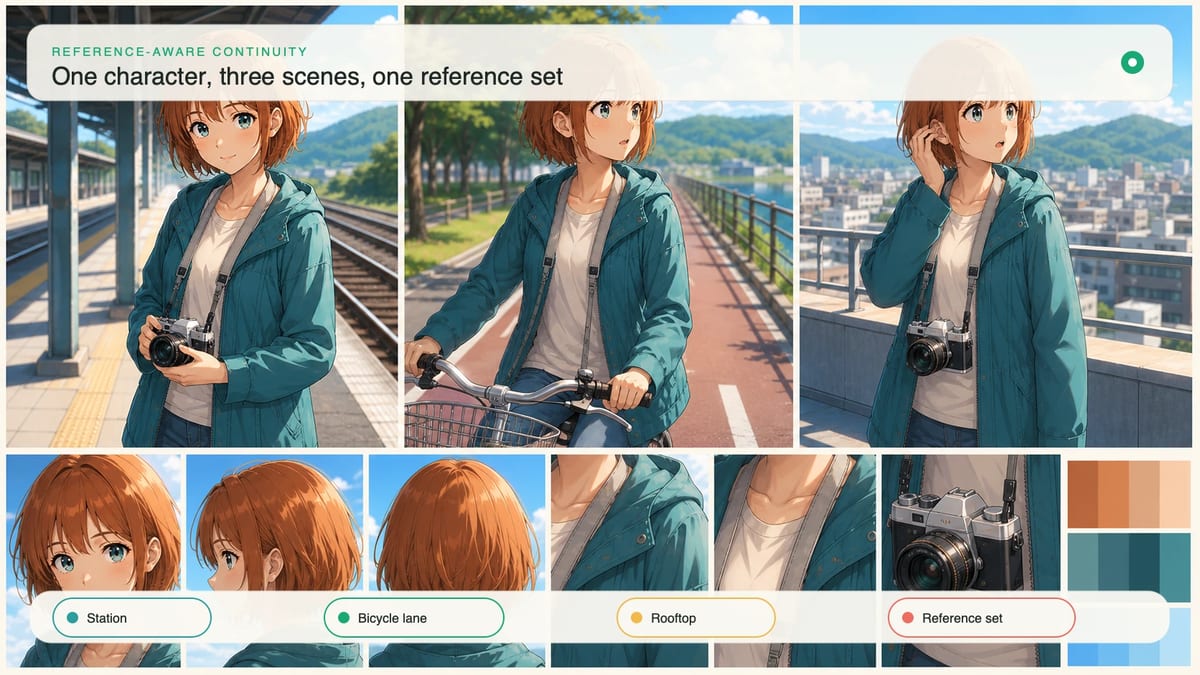
A character can look correct in one frame and still fail as a recurring character. Hair length shifts, an accessory changes sides, jacket construction simplifies, or the face becomes a different person when the camera moves wider.
The same problem affects scenes. A doorway moves to another wall, daylight changes direction, or a prop disappears between storyboard panels. These are not isolated beauty defects; they break the viewer's belief that the shots belong to the same world.
Prompt repetition helps, but prose cannot fully define a face, silhouette, spatial layout, and movement rhythm. The practical response is to separate stable identity from shot-specific change, then make each kind of reference perform one clear job.
Start with an approved visual source of truth. For a recurring character, prepare one readable portrait or three-quarter view, one full-body view, and only the additional angle needed by the next shot. Remove conflicting experiments from the working set.
You can use the anime character creator to develop an original design, then save the approved images with a short identity contract:
Permanent: short copper bob with one longer strand at the right cheek; teal rain jacket with white zipper; silver camera strap worn from right shoulder to left hip; amber eyes; reserved posture.
Variable: facial expression, pose, camera distance, weather interaction, scene lighting.
For a location, keep a simple orientation frame or storyboard panel that shows entrances, major props, and light direction. The set should be small enough that every item agrees.
Different references solve different risks.
| Reference | Use it to protect | Do not expect it to solve |
|---|---|---|
| First frame | Initial pose, framing, wardrobe, location state | The exact ending or full action path |
| Last frame | Destination pose, final composition, object state | How the motion travels between frames |
| First + last frames | A visible start and destination | Every intermediate drawing decision |
| Motion reference | Rhythm, body mechanics, camera or subject movement | Character identity unless identity is also supplied |
| Character reference | Face, hair, silhouette, clothing construction | Shot timing or spatial blocking |
| Storyboard context | Beat order, shot purpose, neighboring continuity | Fine motion inside one generated clip |
Use a first frame when the opening composition carries the continuity burden. Add a last frame when the ending must land on a specific pose or handoff. Use motion reference when the important decision is how movement unfolds, not merely where it starts and ends.
The public Seedance 2.5 reference workflow describes how these inputs fit into the project path. The standalone text generator remains useful for prompt experiments, but it does not accept the same project references.
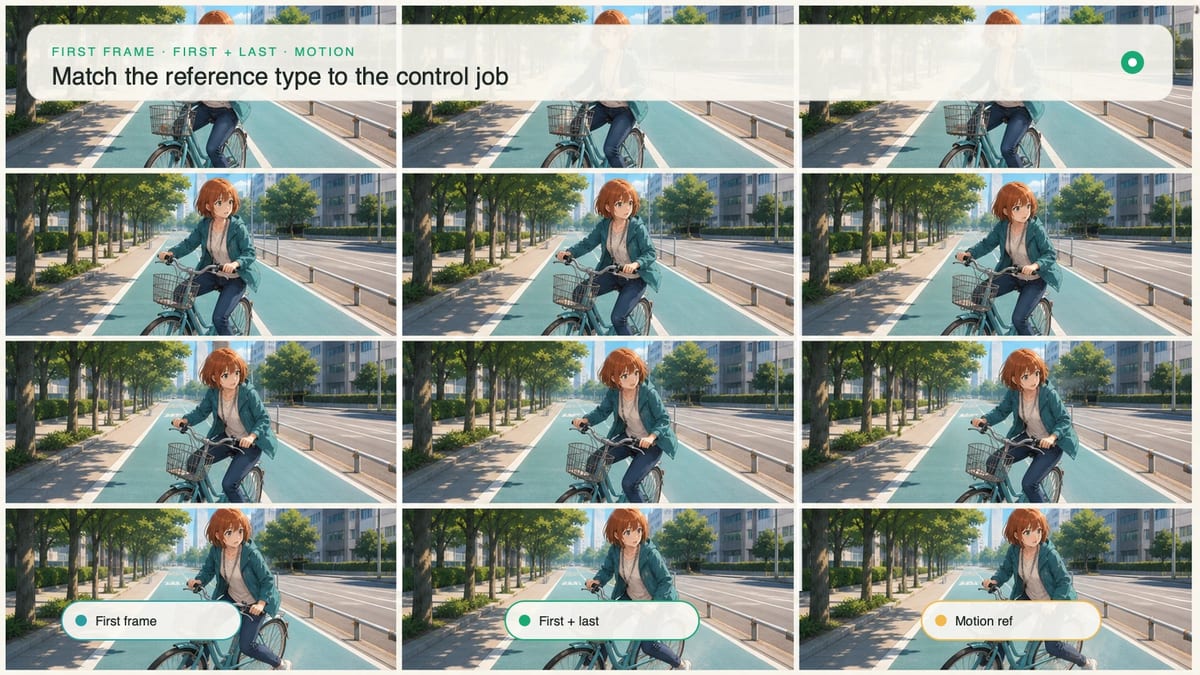
A reference is most useful when it is attached to a specific shot decision. The storyboard says what the shot must accomplish; the character reference says who performs it; the frame or motion reference says how the visible action is constrained.
Inside an AI storyboard generator for anime, review the sequence before generating video. For each shot, record:
This prevents a common failure: using a strong character reference on a shot whose staging still contradicts the prior panel. Identity consistency cannot repair a broken eyeline, reversed exit direction, or missing handoff prop.
More references do not automatically create more control. If two portraits disagree about the hair fringe or two location frames place the door on opposite walls, the model must choose between them. The output may average the designs or switch during the shot.
Keep the set hierarchical:
Remove any reference that does not resolve a named risk. If the shot is a close-up conversation, a full running-motion clip may distract from facial performance. If the shot is a jump, the motion reference may matter more than a second portrait.
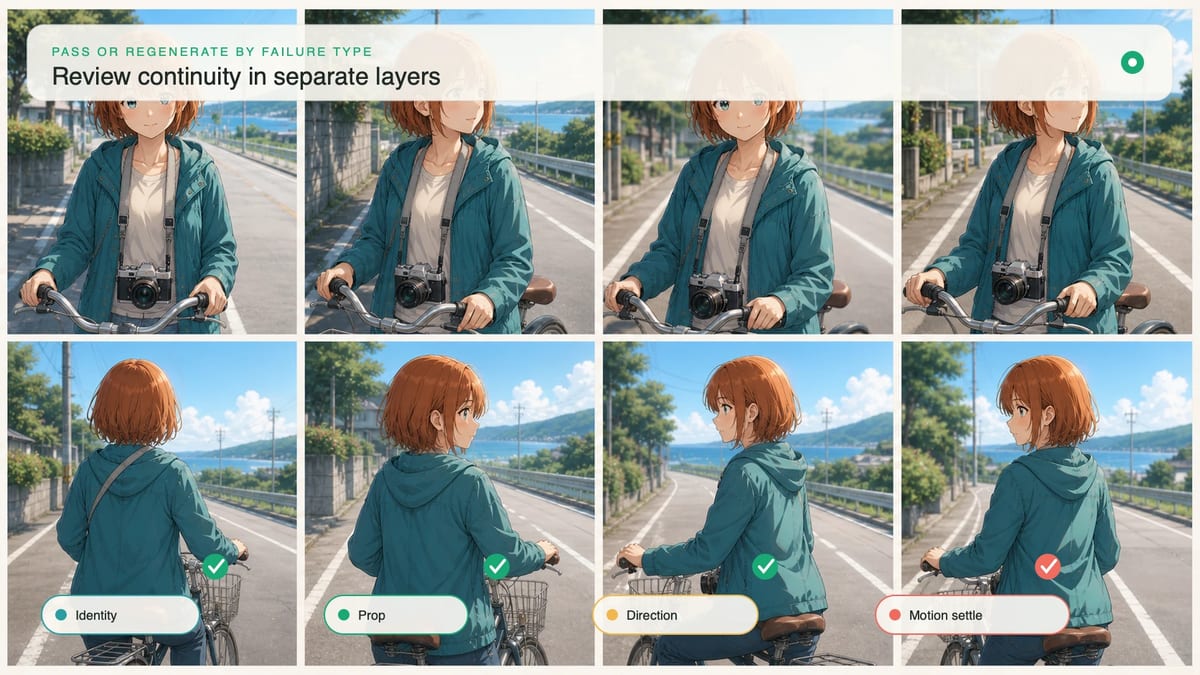
Review in layers. First check identity: face, hair, silhouette, clothing, and signature accessory. Then check props: presence, side, hand, color, and state. Next check space: entrances, screen direction, background landmarks, and light direction. Finally check motion: trigger, body mechanics, camera path, and settle.
A simple scorecard keeps the review factual:
| Layer | Pass condition | Example failure |
|---|---|---|
| Identity | Character is recognizable at the widest required framing | Hair and face change after the turn |
| Props | Required prop remains present and correctly placed | Strap moves to the opposite shoulder |
| Space | Geography supports the storyboard handoff | Character exits right but enters the next shot from the wrong side |
| Motion | Action follows the intended cause and rhythm | Jump begins before the visible trigger |
Do not combine these into one vague “consistency” judgment. The failing layer tells you which reference or prompt decision to revise.
Regenerate when the shot's core visual logic is wrong: the character is no longer recognizable, the prop changes state, the camera crosses the intended axis, or the ending cannot connect to the next panel. Edit when the generated clip is structurally sound and only needs timing, sound, color, or a clean cut around a weak moment.
Change the smallest input that owns the failure. Replace a conflicting character image for identity drift. Clarify the last frame for a weak handoff. Simplify the motion reference when body mechanics become noisy. Revise the storyboard when the shot itself asks for incompatible actions.
The useful result is not a clip that never varies. It is a clip whose important differences are intentional and whose remaining variation can be handled in the next production step.
From inspiration to complete plot, quickly output chapter structure