An episode can have attractive scenes and still feel shapeless. The missing element is usually not “more plot.” It is a visible chain of pressure: something changes, the character chooses, the cost rises, and the final beat makes the next episode necessary.
This anime episode script template turns that chain into fields you can copy, fill, test, and revise before investing in final art or animation.
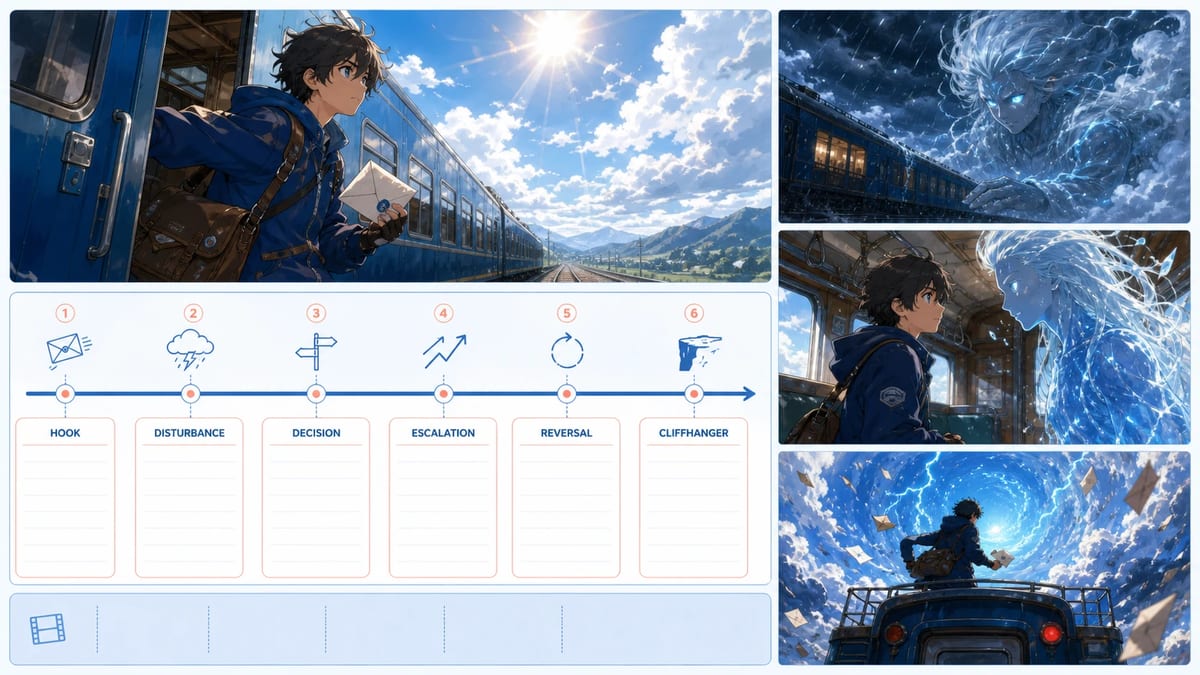
Copy this block into your writing document:
EPISODE TITLE:
EPISODE PROMISE: What emotional or narrative experience should the viewer receive?
STARTING STATE: What does the protagonist believe or want at the beginning?
ENDING CHANGE: What becomes impossible to ignore by the final image?

HOOK (0:00–0:30)
- Immediate image, action, or contradiction:
- Question created for the viewer:

SCENE 1 — DISTURBANCE
- Location and time:
- Character objective:
- New obstacle or information:
- Exit beat:

SCENE 2 — DECISION
- Choice made:
- Reason the choice matters:
- Cost accepted or overlooked:

SCENE 3 — ESCALATION
- Pressure increases because:
- Relationship changes because:
- Visual turning point:

SCENE 4 — REVERSAL
- Expected outcome:
- Actual outcome:
- New meaning of an earlier detail:

FINAL SCENE — CLIFFHANGER OR RESOLUTION
- Immediate consequence:
- Final image:
- Question carried into the next episode:

CONTINUITY NOTES
- Character state:
- Props and injuries:
- Unresolved information:
The template is deliberately short. It forces the writer to expose cause and effect before expanding dialogue. If two consecutive fields can be swapped without changing the episode, the beats are not yet dependent enough.
The episode promise is a creative contract. “A courier discovers her routine delivery is a rescue mission” is more useful than “an exciting episode,” because it identifies the expected turn.
The starting state and ending change measure movement. The protagonist does not need to become a different person, but their knowledge, trust, risk, or goal must shift.
The hook creates attention through a specific contradiction. A train arrives with no driver; a hero wins too easily; a voice speaks from a sealed package. It should create a question the episode actually intends to develop.
The decision is the hinge. Events before it create pressure; events after it reveal consequences. If the protagonist can be removed and the same plot still happens, strengthen this beat.
The reversal changes interpretation, not merely volume. A larger explosion is escalation. Discovering that the person who caused the explosion was protecting someone is a reversal.
Here is a compact filled example:
EPISODE TITLE: The Last Train Above the Storm
EPISODE PROMISE: A rookie courier must decide whether a forbidden passenger matters more than finishing her first official route.
STARTING STATE: Mina believes following the delivery code will prove she belongs.
ENDING CHANGE: Mina deliberately breaks the code and becomes visible to the people hunting her passenger.

HOOK
- Mina jumps onto a train already moving across a lightning bridge.
- The sealed case in her satchel knocks back from inside.

SCENE 1 — DISTURBANCE
- Empty dining car, midnight.
- Mina wants to verify the address without opening the case.
- A child's voice asks whether the next station is safe.
- The train map erases the destination by itself.

SCENE 2 — DECISION
- Mina opens the case and finds a miniature storm spirit.
- She chooses to hide it before the conductor drone arrives.
- Her delivery seal records the violation.

SCENE 3 — ESCALATION
- The drone locks every carriage.
- Mina and the spirit disagree about whom to trust.
- Lightning reveals armed figures waiting at the official station.

SCENE 4 — REVERSAL
- Mina expects the spirit to be contraband.
- It is the only thing keeping the bridge stable.
- The repeated knocking was the spirit matching the bridge's failing rhythm.

FINAL SCENE
- Mina changes the train route toward an abandoned platform.
- Every signal in the valley turns red at once.
- A distant controller says, “Courier identified.”
The important proof is the dependency: opening the case creates the recorded violation; the violation makes the final identification believable. The storm spirit also changes meaning twice—from suspicious object, to passenger, to structural necessity.
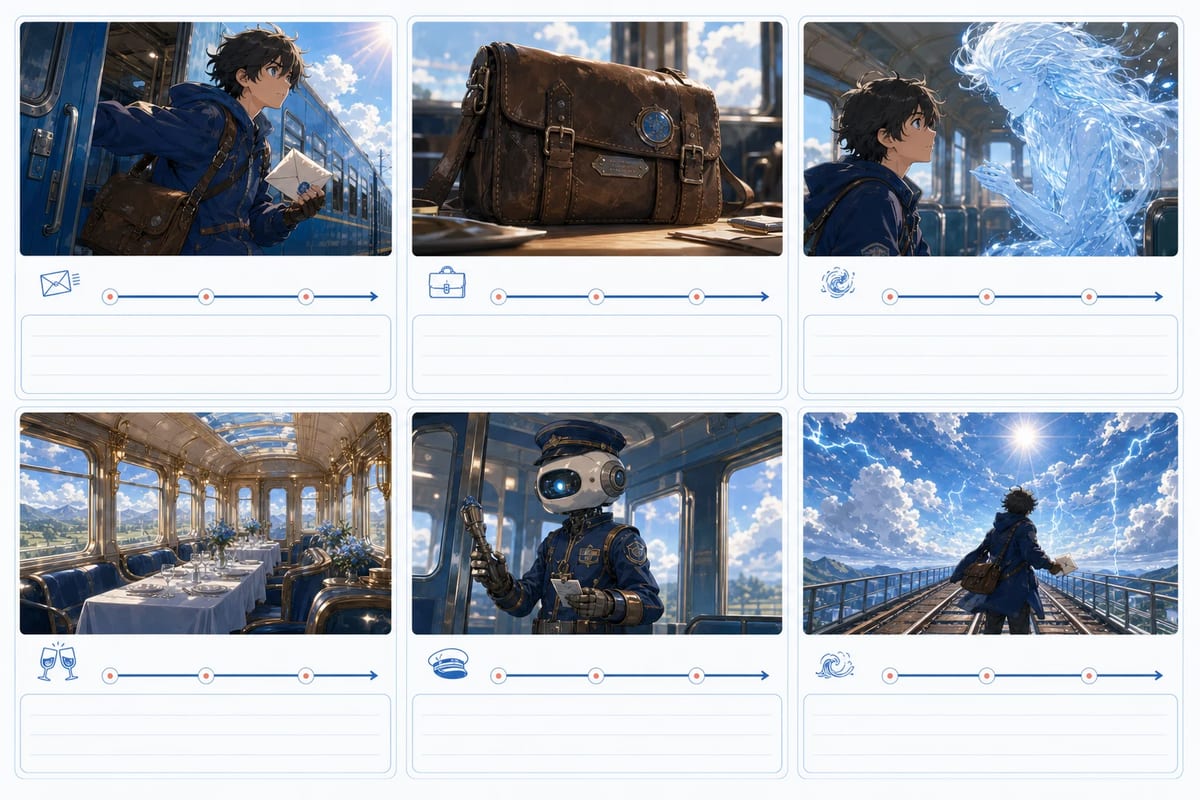
For action, make the decision alter physical options. The hero closes a gate, spends the only power cell, or reveals their position. Track geography and available resources so the escalation feels earned.
For romance, make each beat alter what one character understands or risks revealing. A reversal may be a reinterpreted gesture rather than a secret villain. The cliffhanger should create emotional necessity, not a random interruption.
For mystery, record the question, clue, initial interpretation, and revised interpretation. Every clue should be observable before the explanation. Do not solve a mystery with information that never appeared on screen.
The fields stay the same across genres; the source of pressure changes. That makes the template reusable without making every episode feel identical.
Once the beat chain holds, expand each scene with objective, resistance, action, and exit. An AI anime script generator can help turn the filled fields into a scene draft, but keep the template beside the generated text. Reject any new line or event that breaks the approved cause-and-effect chain.
Use scene headings consistently and keep action paragraphs visual. Instead of “Mina feels afraid,” write the evidence the viewer can see: “Mina presses the delivery seal under her palm before the drone scans the table.” Dialogue should create friction, concealment, or a changed decision—not repeat the action.
Testing Dialogue Before Storyboarding
Read the scene aloud with different voices. If every character can exchange lines without changing the scene, their objectives are too similar. Use an anime voice generator to audition pace, pauses, and emotional restraint before locking timing.
Listen for three failures:
- exposition that both characters already know;
- emotional labels where behavior would be stronger;
- long speeches that stop the pressure instead of changing it.
After the dialogue survives the read-through, move the approved beats into an AI anime storyboard workflow. Storyboarding should test staging and clarity, not repair an episode whose decisions are still unclear.
When the dialogue and beats are approved, use the guide to turn an approved script into a complete anime episode, including characters, scenes, storyboard shots, generated media, dialogue audio, and export.
Treating the hook as unrelated spectacle. A strong opening image should connect to the episode's central pressure or return with new meaning.
Using escalation as repetition. Three attacks of increasing size are still one beat if the character's options and relationships do not change.
Writing dialogue before decisions. Polished banter cannot replace a missing choice. Fill the beat chain first.
Hiding continuity in memory. Record injuries, props, promises, discovered information, and emotional state at the end of every episode.
Ending after the climax without a final image. The viewer needs one precise consequence: an opened door, a changed signal, an unanswered message, or a face that now understands the cost.
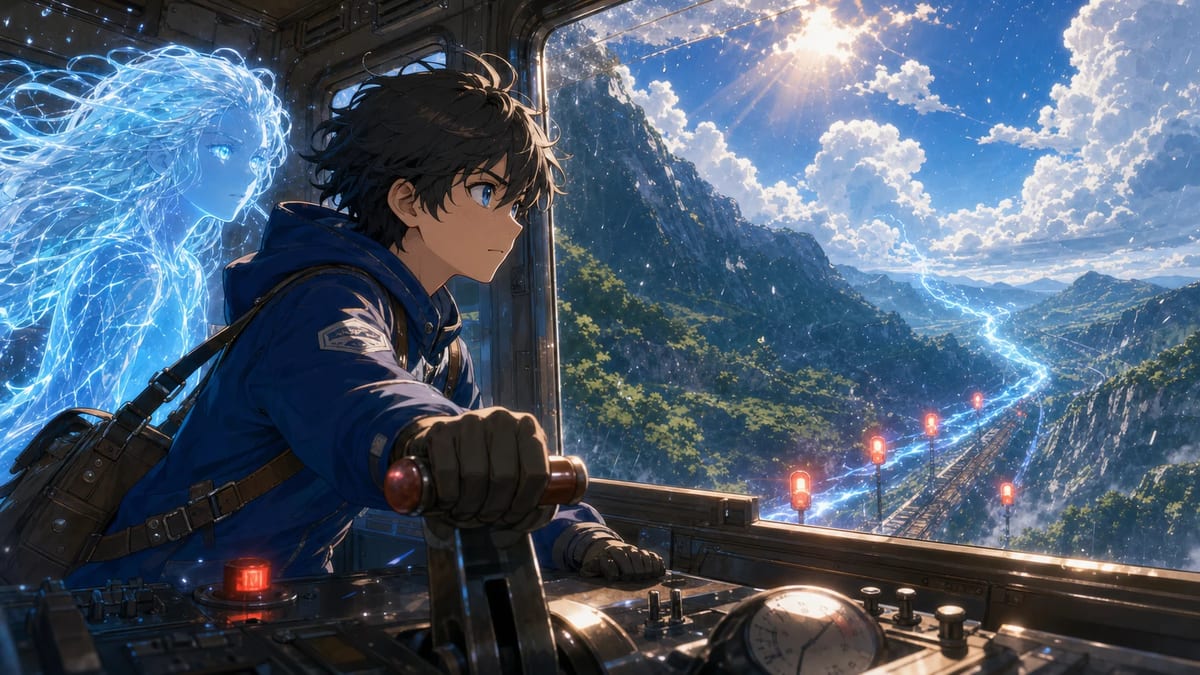
A useful episode template does not write the story for you. It makes the story's load-bearing choices visible early enough to change them cheaply. When every beat changes the next beat, the script is ready to become performance and picture.
