
Back to blog
Aug 2, 2026
Anime Character Prompt Template and Examples | MkAnime
Use an anime character prompt template to define silhouette, face, hair, clothing, colors, and signature details before generating character art.
Aug 2, 2026
Use an anime character prompt template to define silhouette, face, hair, clothing, colors, and signature details before generating character art.
Define the visible identity once, separate it from style and composition, and make every revision easier to diagnose.
By Sonya, Contributor of MkAnime · Published August 2, 2026
Disclosure: Sonya contributes to MkAnime, whose character-creation tool is described in this guide. AI assistance was used to organize and edit the article. The prompt examples and MkAnime product claims were reviewed against the current implementation on August 2, 2026.
An anime character prompt should define the character’s visible identity, face, hair silhouette, body proportions, outfit construction, color hierarchy, signature item, visual style, and intended composition. Keep permanent design traits separate from pose, expression, lighting, and background so you can revise one variable without rewriting the character.
A practical formula is:
Identity + face + hair + body + outfit + palette + signature detail + style + composition and exclusions
The template below turns that formula into a reusable character brief, with worked examples and a checklist for inspecting the result.
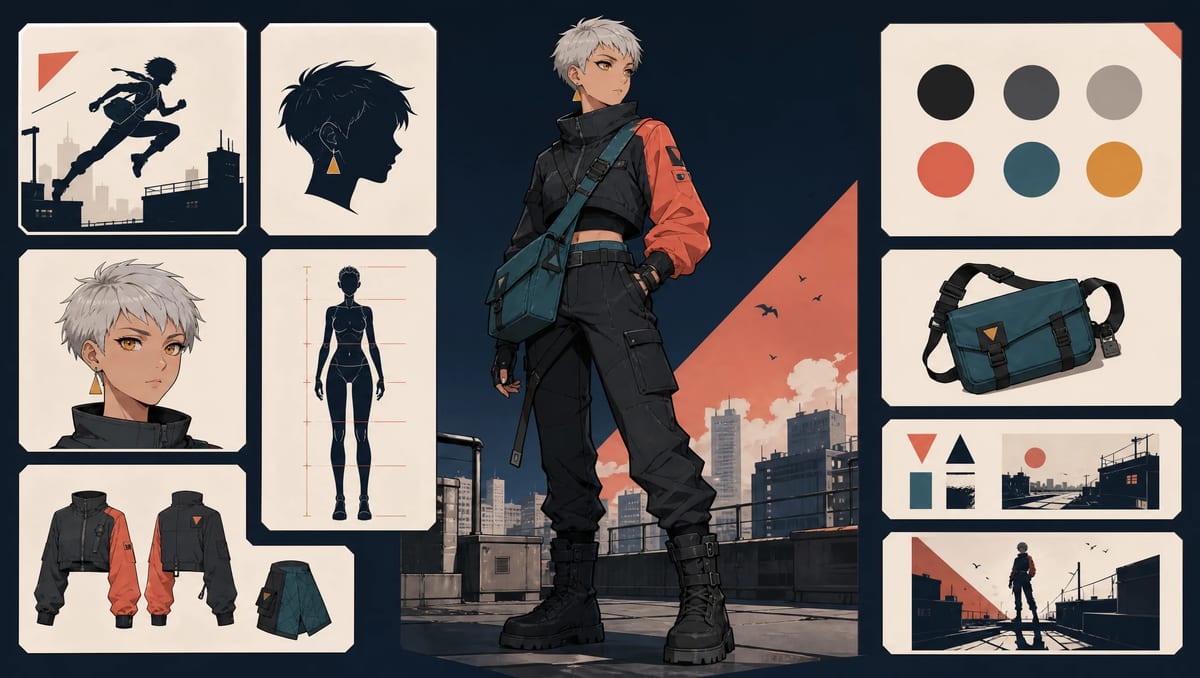
Nine-field infographic for turning a loose character idea into a reusable visual brief.
Consider this idea:
A brave young courier in a futuristic city.
It contains a role, an age cue, a personality trait, and a setting. It does not yet define a character a viewer could recognize reliably.
To turn the idea into a visual design brief, ask what the image can show:
Backstory remains valuable, but an image prompt needs the visible consequences of that story. “Works outdoors during storms” can become a weatherproof cropped jacket, utility boots, and a sealed cross-body satchel. “Disciplined but defiant” can influence posture, clothing maintenance, and one controlled asymmetry.
| Field | What to decide | Example for Mara Vale |
|---|---|---|
| 1. Identity | Name, role, apparent age | young adult rooftop courier |
| 2. Face | Shape, eyes, brows, visible marks | angular face, amber eyes, straight brows |
| 3. Hair | Silhouette, length, color, parting | cropped silver hair, one longer right-side piece |
| 4. Body | Build, proportions, stance | compact athletic build, upright stance |
| 5. Outfit | Garment construction and layers | cropped jacket, fitted trousers, ankle boots |
| 6. Palette | Main, secondary, and accent colors | charcoal, teal, coral, amber |
| 7. Signature item | One recognizable prop or accessory | triangular amber earring on left ear |
| 8. Style | Linework, color, shading, texture | crisp linework, clean cel shading |
| 9. Composition | Shot, angle, background, exclusions | complete full body, neutral pose, plain background |
State the character’s role and an age range that affects the design. A role is useful when it produces visible choices.
Weak:
A mysterious hero.
More usable:
A young adult rooftop courier who works in bad weather and carries sealed deliveries across the city.
The second version suggests practical clothing and equipment. Avoid packing the prompt with biography that cannot appear in the image.
Describe a few stable facial traits:
Expression belongs in a variable block unless it is part of the character’s default design presentation.
Hair is often one of the strongest identity cues. Define:
“Short silver hair” still leaves many interpretations. “Cropped silver hair with a compact rounded back and one longer piece over the right eyebrow” creates a more inspectable silhouette.
Use neutral, observable language. Specify height impression, build, limb proportions, and the pose needed for the asset.
For a design sheet, a readable neutral stance usually reveals more than a dramatic action pose. If the final project needs action, test that after approving the basic design.
Describe clothes as garments that could be assembled:
“Stylish cyberpunk clothes” is open to broad reinterpretation. “Short charcoal weatherproof jacket ending above the hips, high folded collar, one coral left sleeve, visible front zipper” gives the result structural constraints.
Assign a job to each color:
For Mara, charcoal is the main outfit color, teal belongs to the satchel, coral appears on one sleeve, and amber connects the eyes and earring.
A signature item can be an accessory, prop, garment feature, or recurring emblem. One meaningful item is usually easier to preserve than six unrelated accessories.
Place it precisely:
One triangular amber earring on the character’s left ear; right ear has no earring.
Directional details still require visual inspection because generated images may reverse or omit them.
Describe style through controllable visual properties:
Keep this block separate from the identity. The same character can be rendered in clean cel shading, watercolor, or manga ink without changing the hair, outfit, palette, and proportions.
State what the final image must show:
For a full-body design, use direct language:
Complete character visible from head to toe, both feet inside the frame, neutral standing pose, clear space around the silhouette, plain background.
Avoid conflicting instructions such as “close-up full-body portrait.”
Copy this version and replace the bracketed fields:
[CHARACTER NAME], [ROLE AND APPARENT AGE], with [BODY BUILD AND PROPORTIONS].
[FACE SHAPE, EYES, BROWS, AND VISIBLE FACIAL TRAITS].
[HAIR SILHOUETTE, LENGTH, COLOR, TEXTURE, AND PARTING].

Wearing [GARMENT TYPES, CONSTRUCTION, LAYERS, MATERIALS, AND COLOR PLACEMENT].
Carries or wears [ONE SIGNATURE ITEM AND ITS EXACT LOCATION].
[POSE AND VISIBLE ATTITUDE].

Rendered with [LINEWORK, COLOR, SHADING, LIGHTING, AND TEXTURE DIRECTION].
[SHOT SIZE, CAMERA ANGLE, ASPECT RATIO, AND BACKGROUND].

Keep [THREE IDENTITY ANCHORS] clearly visible.
Avoid [SPECIFIC CONFLICTING DETAILS, CROPS, EXTRA ACCESSORIES, OR SCENERY].
Use the template as a decision checklist. Remove fields that do not help the intended asset and keep longer lore in a separate project document.
A brave young futuristic courier, detailed anime art.
Mara Vale, a young adult rooftop courier with a compact athletic build and upright posture.
Angular face, amber eyes, straight brows. Cropped silver hair with one longer piece falling over the right eyebrow.

Short charcoal weatherproof jacket ending above the hips, high folded collar, one coral left sleeve, visible front zipper, fitted dark utility trousers, heavy black ankle boots. Teal cross-body satchel and one triangular amber earring on the left ear.

Clean cel-shaded anime illustration with crisp linework, restrained highlights, and simple color blocks. Neutral standing pose, complete full body from head to toe, plain warm-gray background.

Keep the silver hair silhouette, coral left sleeve, and left-ear earring visible. Avoid long coats, skirts, high heels, helmets, scenery, extra jewelry, and cropped feet.
The structured version makes three identity anchors explicit and separates them from style and framing. It also provides specific exclusions that protect the intended silhouette.
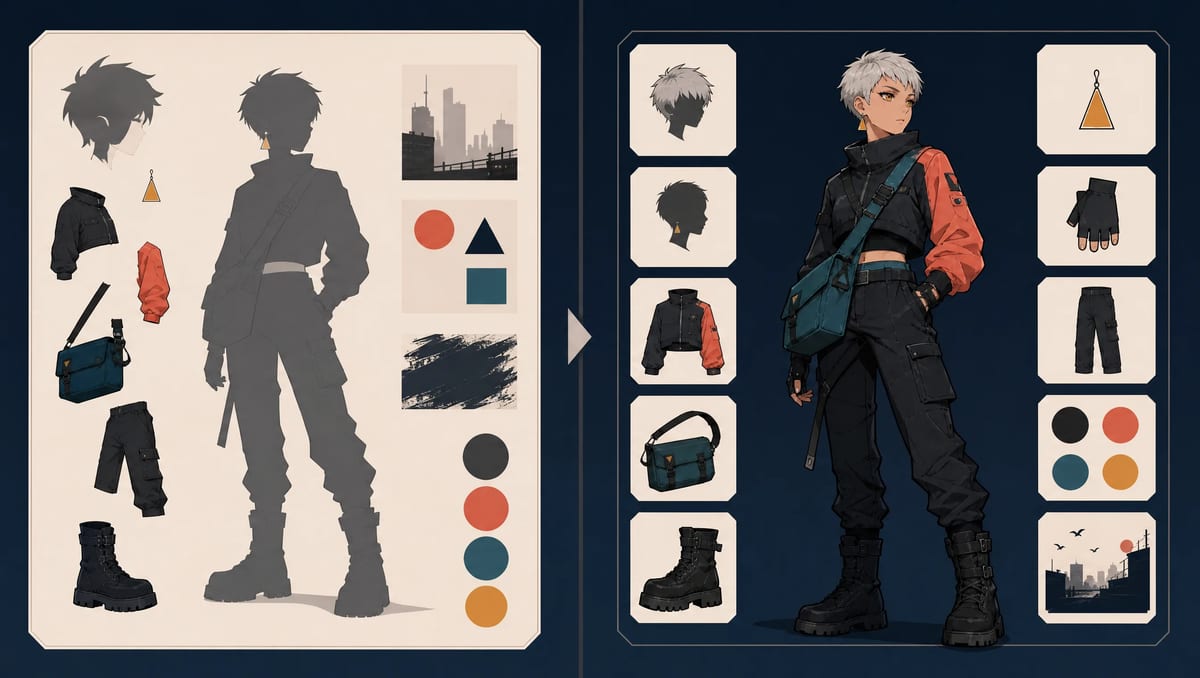
Comparison showing how a structured brief makes the intended character easier to inspect than a vague description.
Emi Sato, a university radio host in her early twenties, slim average-height build, warm oval face, dark brown eyes, chin-length black bob with a copper hair clip on the right side. Cream cardigan over a navy shirt, high-waisted rust skirt with practical side pockets, dark tights, low brown boots, compact silver field recorder on a blue strap. Soft clean anime illustration, gentle linework, muted autumn palette, light cel shading. Complete character visible in a relaxed three-quarter standing pose on a pale background. Preserve the black bob, copper hair clip, blue recorder strap, and cream-navy-rust palette. Avoid school uniforms, microphones, headphones, and room scenery.
Ilya Ren, an adult botanical archivist from a mountain city, tall narrow build, calm long face, moss-green eyes, dark auburn hair tied into a low loop with two loose temple strands. Layered sage tunic under a weathered brown field coat with a split back hem, dark green trousers, leather walking boots, brass specimen case at the belt, one pressed fern inside a transparent shoulder badge. Painterly anime concept illustration with controlled watercolor texture and readable garment edges. Full-body front three-quarter view on a parchment-colored background. Preserve the looped hair, specimen case, fern badge, and sage-brown palette. Avoid wizard robes, glowing magic, weapons, and forest scenery.
Piko, a small mechanical fox courier mascot with a large rounded head, compact body, two triangular ears of unequal height, charcoal metal shell, one coral face panel, teal tail light, and a single amber parcel tag attached to the left side. Bold graphic anime mascot design, thick clean outlines, flat color, minimal shading. Complete front three-quarter view on white, centered with clear negative space. Preserve the uneven ears, coral face panel, teal tail light, and left-side amber tag. Avoid realistic fur, complex machinery, scenery, text, and extra limbs.
Each example converts a role into visible equipment, a controlled palette, and a small set of anchors.
When the output fails, identify the field responsible before rewriting the whole prompt.
| Output problem | Likely field | Focused revision |
|---|---|---|
| Jacket becomes a coat | Outfit construction | short jacket ending clearly above the hip bones; no coat tails |
| Feet are cropped | Composition | both boots fully inside frame with space below soles |
| Earring moves sides | Signature item | one earring on character's left ear; right ear empty |
| Character becomes too ornate | Outfit / exclusions | remove optional accessories; add no extra jewelry or armor |
| Watercolor obscures seams | Style | controlled watercolor texture with crisp garment boundaries |
| Background dominates | Composition | plain background, no scenery or foreground objects |
Keep a revision log with the prompt, output, changed field, and result. A controlled test provides more information than a complete rewrite.
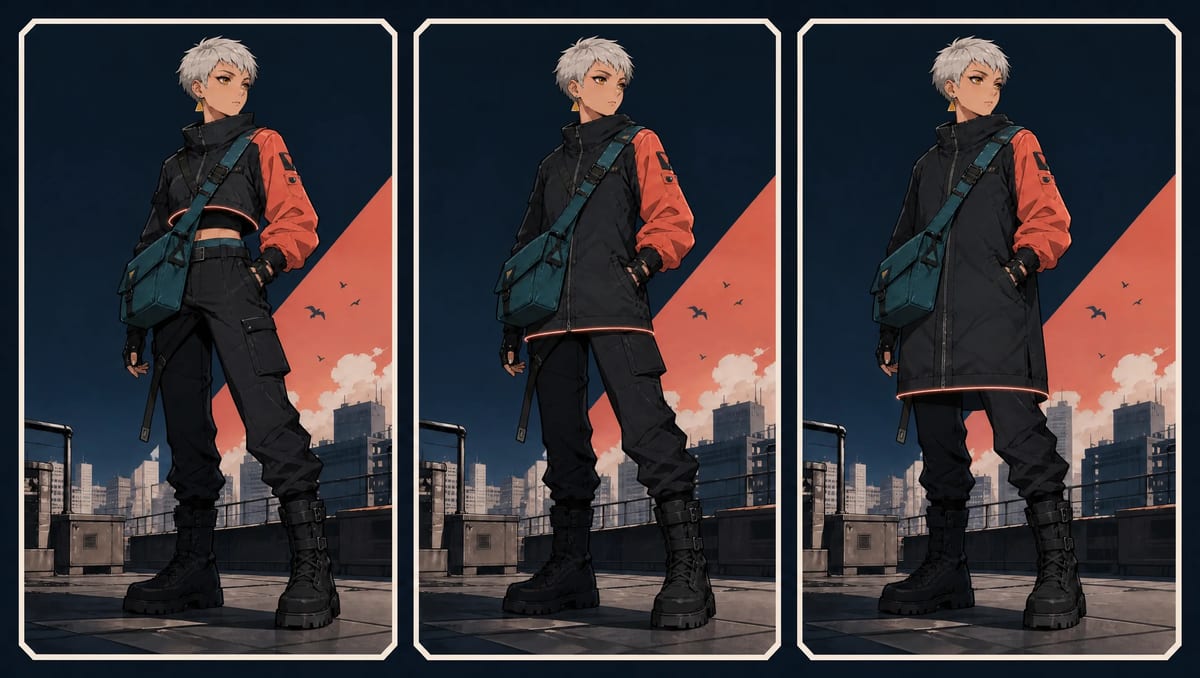
Revision example in which only the jacket-length instruction changes between passes.
A portrait may hide missing shoes, unclear layers, or a weak side silhouette. Review the design at full length and from more than one angle.
Ask:
A repeated problem across views usually points to the brief. A problem in one view may reflect pose, angle, or generation variation.
The MkAnime AI anime character creator currently provides a focused character-design workflow:
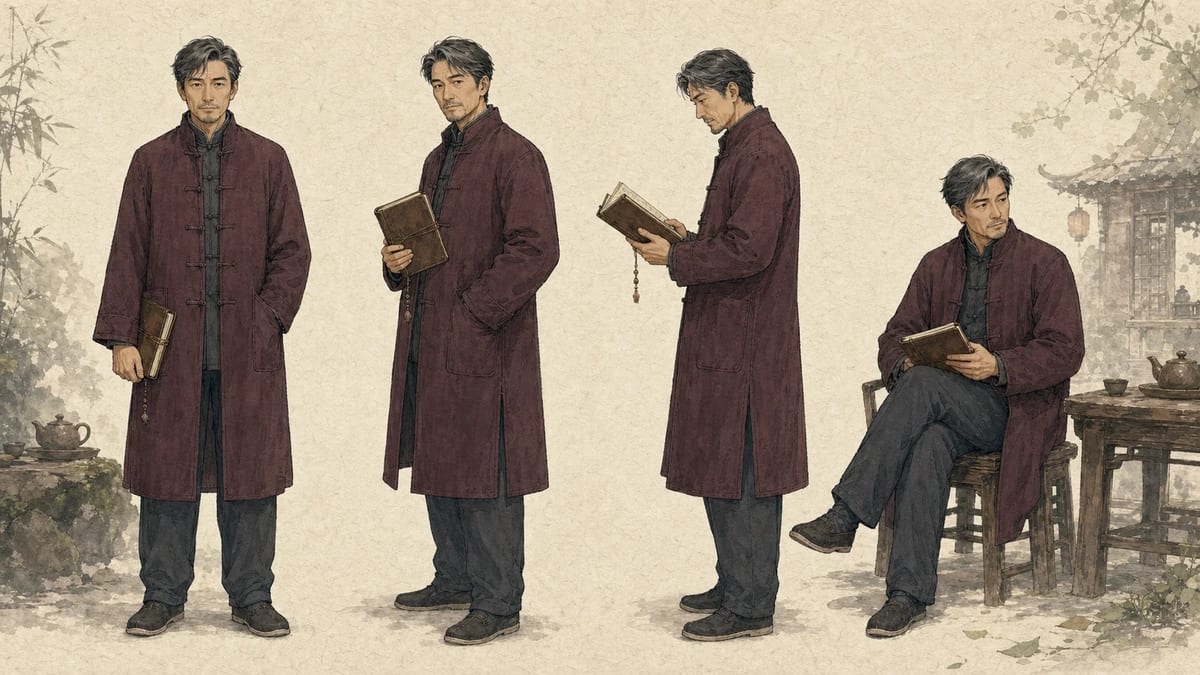
Example MkAnime output bundle with a complete character image and a separate three-view reference sheet.
The two generated assets give you several places to check the prompt. They do not guarantee that every detail will remain identical. Use the anime character reference sheet guide for a deeper multi-view workflow, and the character-consistency guide when the character must recur across shots.
Once the identity block is stable, compare different anime art styles for character design without changing the fixed silhouette, color placement, or signature details.
Before generating, confirm that the prompt answers these questions:
Continue with the anime character design checklist when you need to evaluate the underlying visual design rather than the wording alone.
Use enough words to record the visible decisions that matter. A simple concept may need 50–100 words, while a production-oriented brief may need 150–250. Remove repeated adjectives, invisible backstory, and conflicting instructions before adding more detail.
Use identity cues that work at different scales: a hair or head silhouette, one large color block, distinctive outfit proportions, and one smaller signature detail. Keep the most important three anchors stable during revisions.
Include personality when it changes something visible, such as posture, grooming, clothing maintenance, color, or a meaningful item. Store longer motivation and history in a separate character document.
Request a complete figure from head to toe, both feet inside the frame, a readable standing pose, clear space around the silhouette, and a simple background. Avoid mixing full-body language with close-up framing.
A stable prompt reduces unnecessary reinterpretation but cannot guarantee continuity. Approve visual references, reuse them where supported, and run controlled tests when a character must recur across multiple shots.
An effective anime character prompt is a reusable record of visible design decisions. Define identity anchors, describe clothes as a construction, rank the colors, separate style from character design, request the required framing, and revise one field at a time.
The prompt gives the project a clear starting point. The generated assets show which decision needs attention next.
Sonya is a contributor to MkAnime and works on content research, product communication, and practical AI-anime production workflows.
From inspiration to complete plot, quickly output chapter structure